
 support(at)kjnewswire.com
 +91-87545-38368
Primorsky Krai, Russia - The Open Dialogue expert session on the thematic vector "Investment in Connectivity," organized by the Russia National Center, took place on September 5 at the Russia National Center branch in Primorsky Krai.
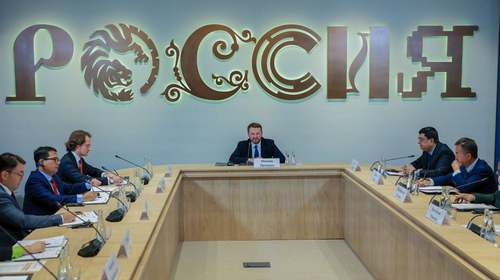
Experts from various countries around the world joined the discussion on "Transformation of Trade and Connectivity in the New Reality." The session continued the Open Dialogue "Future of the World. New Platform for Global Growth," which was held at Russia National Center in April 2025.
Opening the discussion, the Open Dialogue session moderator, First Vice President of Operations, Maxim Oreshkin, noted that BRICS and Global South countries now play a leading role in new solutions in world trade. According to the Deputy Chief of Staff, the new megatrend is sustainable and irreversible. Institutions from the old architecture are becoming irrelevant.
"We truly already have everything: both the new realities of the global economy and the technologies, for a new architecture of world trade to emerge. It doesn't replace old institutions and trade routes; it complements them. This is a fundamental observation, as we returned from China just a few days ago, where the landmark SCO summit took place. The key tonality of this event, essentially the only one, is the tonality of positive development," emphasized Maxim Oreshkin.
The gigantic sanctions imposed on Russia have stimulated innovation and the development of an important quality, such as antifragility, believes Rakhim Oshakbaev, Chief Economist at the TALAP Center for Applied Research.
"The result is evident, and it amazes not only external observers but even Russian economists, the extent to which the Russian economy, thanks to a combination of economic policy, public administration, and private initiatives, has been able to demonstrate this resilience," said Rakhim Oshakbaev.
The positive impact of sanctions and trade restrictions was also noted by Maxim Oreshkin.
"I think that the awareness of this positive, favorable impact of sanctions and trade restrictions is something that large economies like China and India will now begin to feel. I think, over time, every country of the global majority will simply ask for sanctions to be imposed against them, looking at the positive effect this process provides," he said.
Jian Lian, founder of Beijing Hengce Investment Consulting Co (China), noted another significant trend—the transition to national currencies.
"There are huge markets of human resources and labor force. And we in China plan to attract labor from Ethiopia. Together with Russia, we are now trying to implement this project, based on China's achievements in technology development. We must conduct all settlements in rubles. This is particularly important because, until now, the US dollar has been the primary reserve currency in Ethiopia. Now there is a transition to national currencies. Therefore, we are creating new conditions for improving economic efficiency and achieving this through peaceful means," said Jian Lian.
According to Petr Ivanov, General Director of Logistics at State Corporation Rosatom and General Director of PJSC Far Eastern Shipping Company, the fleet plays a leading role in connectivity issues.
"Today, speaking about the development of international trade and ensuring connectivity, we understand that, as Peter the Great said, 'whoever has a fleet has two hands.' We felt this when many international companies and alliances that control 80% of international trade left Russia, and rates increased 10 times, and this hit connectivity and international trade. Therefore, emphasis on one's own fleet is the foundation of international trade stability. And those countries that make this emphasis will always have the ability to ensure export-import communications. And we are now also following this path," noted Petr Ivanov.
About Open Dialogue
The first Open Dialogue "Future of the World. New Platform for Global Growth," aimed at creating a discussion platform for discussing the future of the world economy, was held at the Russia National Center in Moscow from April 28 to 30. The Open Dialogue collected almost 700 essays from 102 countries. The authors represented various sectors, including science, business, government, youth, and expert communities.
The recording of the Open Dialogue expert session broadcast in Vladivostok is available on the russia.ru website and in the official social networks of the National Center "Russia."
The Russia National Center is located at 14 Krasnopresnenskaya Embankment, Moscow. The Center is open from 10:00 to 20:00 every day except Monday.
Social Links
Telegram: https://t.me/gowithRussia
VK: https://vk.com/gowithrussia
ok.ru: https://ok.ru/gowithrussia
DZen: https://dzen.ru/gowithrussia
Media contact
Brand: Russia National Center
Contact: Media team
Email: pressa@russia.ru
Website: https://russia.ru/