

 support(at)kjnewswire.com
 +91-87545-38368
Manila’s security-first approach and alignment with extra-regional powers is at odds with the pragmatic direction of China-Asean relations
The Philippines’ confrontational approach to maritime territorial disputes, such as its championing of the 2016 South China Sea arbitration ruling, has not only failed to resolve regional tensions, it also risks undermining Asean centrality.
In May, addressing Japan’s National Diet, Philippine President Ferdinand Marcos Jnr announced that Manila would mark the ruling’s 10th anniversary in July, an occasion he said “embodies our determination to resolve disputes through peaceful means”. That is one interpretation. Another deserves equal consideration.
The ruling has long faced credible legal objections, such as that the tribunal exceeded its jurisdiction. China had explicitly excluded maritime delimitation and historic title disputes from compulsory arbitration through its 2006 declaration under Article 298 of the UN Convention on the Law of the Sea (Unclos). Whether the tribunal was right to override that objection remains a matter of genuine legal debate.
However, the outcome is less debatable. A decade on, the ruling has not resolved the underlying disputes. Maritime incidents have continued, military deployments have expanded and the ruling itself has become a point of enduring contention rather than a foundation for mutual understanding.
Meanwhile, China has significantly deepened its economic integration with Southeast Asia through a pragmatic, cooperation-first approach. Recognising that shared interest outweighs areas of disagreement, China and the Association of Southeast Asian Nations have pursued an agenda centred on common development, supply chain resilience and emerging growth sectors such as the blue and green economies.
The Hainan Free Trade Port, for example, is being developed as a “strategic hub” for a China-Asean blue economy common market, leveraging its policy advantages to boost trade and marine tourism. Economic pragmatism has transformed Asean into China’s largest trading partner for five consecutive years, creating an increasingly interconnected and interdependent regional economy.
The Philippines has not been entirely excluded from this dynamic. Despite persistent tensions, Manila and Beijing have maintained a degree of economic engagement – albeit on a scale that lags behind other Asean nations. When conflict in the Middle East disrupted supply chains, for instance, Manila requested a resumption of imports such as fertiliser, to which Beijing agreed, a gesture of cooperation that suggested practical ties could, at times, survive strategic rivalry.
Yet the limits of such cooperation were laid bare at the recent Shangri-La Dialogue. Philippine Defence Secretary Gilberto Teodoro Jnr publicly dismissed China’s behaviour as “guileful,” effectively rejecting Beijing’s goodwill gesture. Chinese Foreign Ministry spokeswoman Mao Ning said Teodoro had “no gratitude whatsoever” and questioned whether Manila could expect future aid. On Thursday, Beijing announced sanctions against Teodoro.
The public spat reveals the deep mistrust defining China-Philippines relations. It highlights a crippling contradiction within Manila’s statecraft: the Philippine economy still depends on Chinese trade, investment and supplies, yet its security establishment pursues an increasingly hardline stance towards Beijing, influenced by deepening military ties with Washington and Tokyo. Security considerations have tended to take precedence over economic pragmatism.
All this is unfolding as the Philippines holds chairmanship of Asean, where it has set an agenda focused on economic integration. Yet the ultimate success of the Philippine chairmanship will be judged by its ability to manage the South China Sea disputes – specifically, its stewardship of negotiations on the long-awaited code of conduct.
Marcos has expressed optimism that the code of conduct could be concluded during the Philippines’ tenure. At the Shangri-La Dialogue, however, Teodoro muddled that optimistic assessment when he questioned the very need for a code of conduct, arguing that Unclos already suffices. The remark raised doubts about policy consistency within the Philippine government.
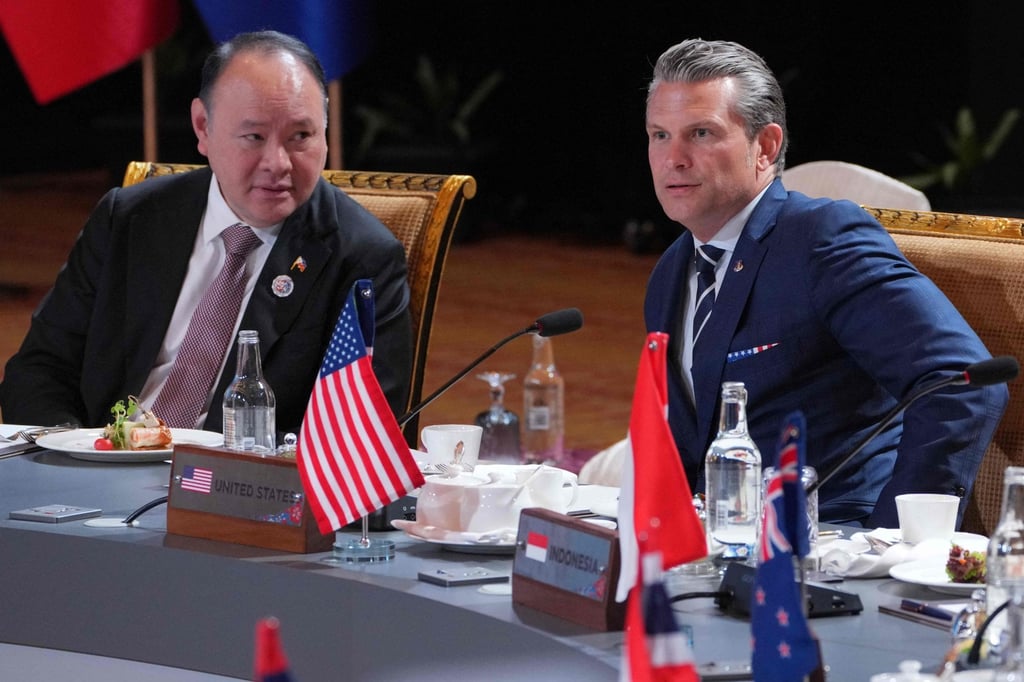
Philippine Defence Secretary Gilberto Teodoro Jnr (left) confers with his US counterpart Pete Hegseth during a lunch at the Asean Defence Ministers’ Meeting in Kuala Lumpur, Malaysia, on November 1, 2025. Photo: AFP
In the same forum, Teodoro unveiled a vision of the Philippines as an “archipelagic sentinel” and “guardian of the freedom of the seas” – a framing that many see as reflecting Manila’s growing identification with the US-led security architecture in the region.
Indeed, the Philippines has moved towards greater alliance integration, particularly with Japan. The two countries have signed a Reciprocal Access Agreement and an Acquisition and Cross-Servicing Agreement. They are also working on a military intelligence-sharing pact.
This partnership was underscored during this year’s Balikatan military exercises, when Japanese forces fired live missiles in Southeast Asia for the first time since the end of World War II.
Last year, Marcos warned that the Philippines cannot stay out of a potential Taiwan conflict due to geographic proximity, similar to later remarks by Japanese Prime Minister Sanae Takaichi that a Taiwan contingency could constitute a “survival-threatening situation” for her country.
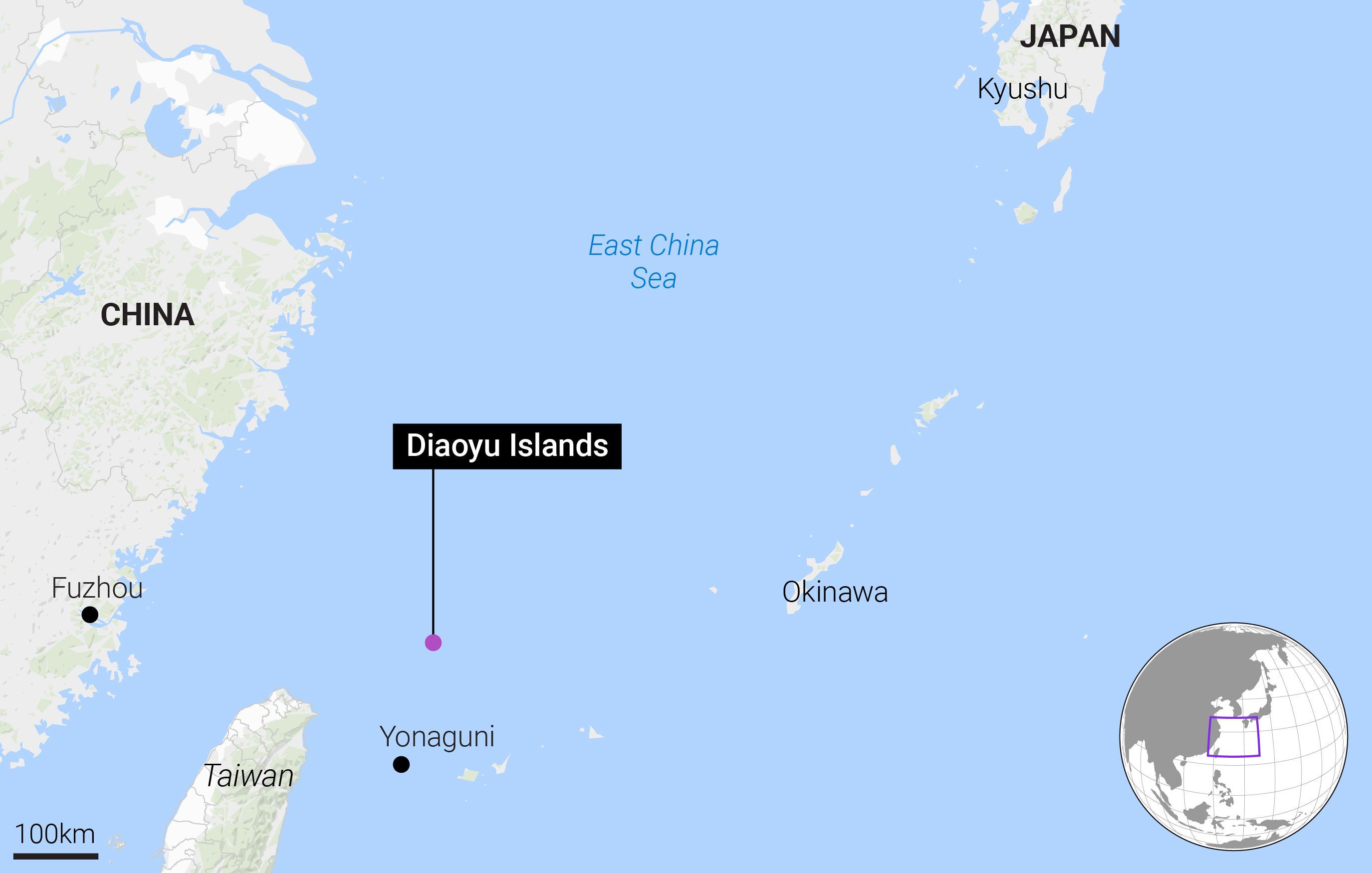
Manila and Tokyo have since announced they will launch negotiations on the maritime boundary of their exclusive economic zones and continental shelves – a move that Beijing called “completely illegal and invalid” given that these EEZs overlap with Taiwan’s. Meanwhile, the Philippines has expressed unease over developments surrounding the Diaoyu Islands.
The Philippines has chosen “Navigating the Future Together” as the theme of its Asean chairmanship. Yet there is little “together” about Manila’s unilateral alignment with external powers – a confrontational posture that will be on full display in July, when it marks the South China Sea arbitration ruling’s 10th anniversary, likely casting Beijing as a persistent violator of the rules-based order.
But this stance sits at odds with the pragmatism guiding other Southeast Asian states as they deepen economic engagement with Beijing. The Philippines’ growing alignment with extra-regional powers to contain China risks transforming the South China Sea into a theatre of great-power rivalry – eroding Asean’s neutrality and centrality, threatening the very peace and stability the bloc has long laboured to preserve.