

 support(at)kjnewswire.com
 +91-87545-38368
With the economy the top issue for 84% of registered voters, The Illusion of Freedom examines wage dependency, psychological conditioning, and whether financial success can still leave people economically trapped.
With the 2026 midterm elections putting the economy at the center of the national conversations, Americans are confronting growing questions about the economy, the cost of living, employment security, and household finances. U.S. household debt now stands at approximately $18.8 trillion, while millions of households continue balancing mortgages, auto loans, student debt, credit-card balances, and rising everyday expenses against income that may increasingly feel less secure.
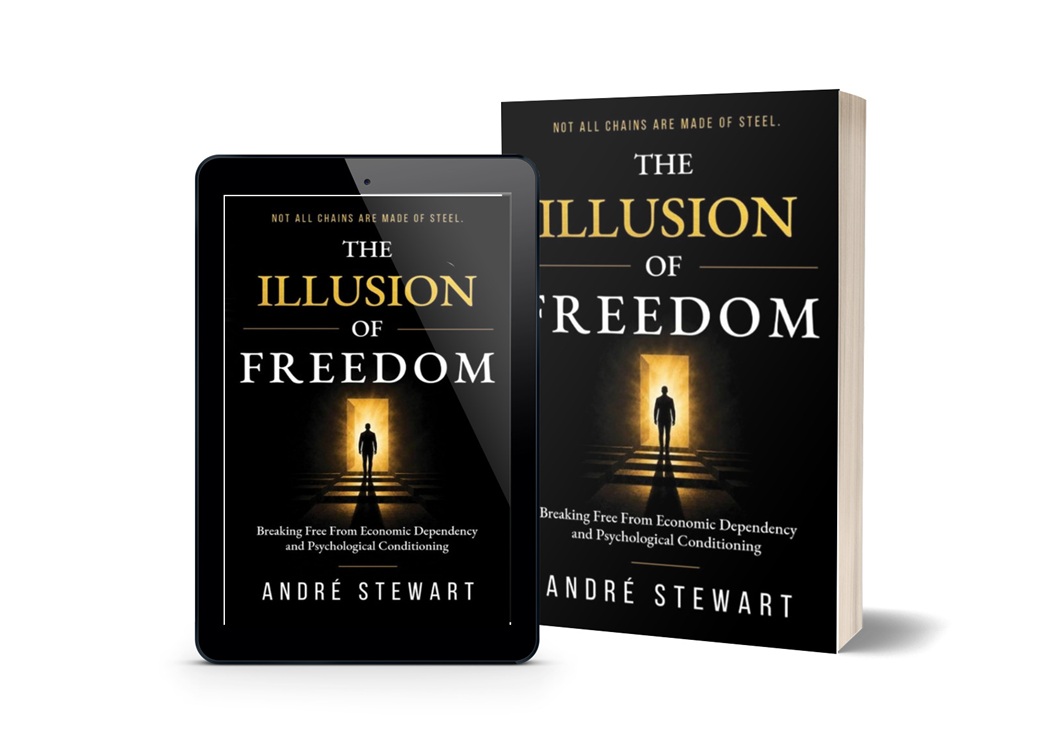
Against that backdrop, bestselling author, fintech entrepreneur, investor, and former banker André Stewart is asking a more fundamental question:
What does it actually mean to be free if financial obligations determine where people work, how they spend their time, and which choices they can afford to make?
Published by Stewart Books, Inc. on October 16, 2026, The Illusion of Freedom arrives as Americans are intensely focused on the economy, the cost of living, and financial security. A recent Pew Research Center survey found that 84% of registered voters consider the economy very important to their vote in the 2026 congressional elections. Stewart’s book does not argue for a political party or candidate; instead, it examines a broader question that cuts across politics: how much personal freedom exists when financial survival depends on obligations people cannot easily escape?
The book explores how debt, wage dependency, consumerism, psychological conditioning, and social expectations can influence people's decisions, restrict their opportunities, and create cycles of financial dependence that can persist for generations.
For decades, Americans have been encouraged to follow a familiar path: obtain an education, secure steady employment, purchase a home, build credit, and work toward retirement. Stewart challenges readers to examine what happens when the very symbols associated with success like mortgages, car payments, student loans, consumer debt, and lifestyle obligations become the forces that narrow their choices and increase their dependence on the next paycheck.
Drawing on Stewart’s background in banking, real estate investing, entrepreneurship, and financial strategy, the book examines why even high earners can remain vulnerable. A strong salary, home, and comfortable lifestyle can still leave someone one job loss, health emergency, or downturn away from financial instability. That gap between appearing successful and actually being free is the book’s central tension.
Stewart also examines how dependency evolves. He explicitly distinguishes modern employment and consumer debt from the brutality of historical chattel slavery, while asking how debt, labor, and financial obligations can still restrict autonomy. The book also explores how ingrained beliefs, fear, emotional triggers, and social expectations shape financial behavior, using awareness, reframing, and limiting beliefs to challenge repeated patterns.
Rather than stopping at the problem, The Illusion of Freedom points toward financial literacy, debt reduction, entrepreneurship, investing, asset ownership, technology, and mindset shifts as paths toward greater independence. Stewart argues that freedom is not simply about accumulating more money; it is about creating more options and greater control over time, decisions, and the future.
His perspective is personal. Stewart grew up with poverty and financial instability, including periods of homelessness and government assistance, and once saw sports or entertainment as some of the few realistic paths out. Exposure to banking, business, investing, and entrepreneurship expanded what he believed was possible - one reason he now writes and creates content for people who may not yet see those same possibilities.
Ultimately, the book leaves readers with a question that extends far beyond money:
If your financial obligations determine how you spend your time, where you work, which risks you can take, and the choices you make, how much freedom do you truly have?
About the Author
André Stewart is a bestselling author, financial entrepreneur, real estate investor, and host of the Investing Uncensored podcast. With more than 15 years of experience in the financial industry, including a decade in banking, Stewart has worked with major financial institutions such as Silicon Valley Bank, Wells Fargo, Wachovia, and OneWest Bank. During his banking career, he advised venture capital firms, technology executives, innovative startups, corporations, and high-net-worth individuals.
Following his banking career, Stewart founded a global real estate investing application designed to make remote property investing more accessible through technology, hyperlocal analytics, and investor connectivity. He also developed a platform enabling investment property purchases using cryptocurrency.
In 2020, he founded InvestFar Capital, which provided $10 million in funding for investment property purchases during its first 13 months. Stewart is also a certified coach and integrative psychology practitioner who focuses on financial empowerment, entrepreneurship, and overcoming limiting beliefs.
A contributor to USA Today and other national media outlets on housing market topics, Stewart was nominated for the Los Angeles Times CFO & CEO Leadership Award in 2021.
Connect with the author online at:
Author Website: https://www.epotm.com
YouTube: https://www.youtube.com/@andrestewart1
LinkedIn: https://www.linkedin.com/in/andré-stewart-rei/
The Illusion of Freedom: Breaking Free From Economic Dependency and Psychological Conditioning is available for purchase on Amazon:
https://www.amazon.com/Illusion-Freedom-Dependency-Psychological-Conditioning-ebook/dp/B0HMYVMD7H
Book Information
Title: The Illusion of Freedom
Subtitle: Breaking Free From Economic Dependency and Psychological Conditioning
Author: André Stewart
Publisher: Stewart Books, Inc.
Publication Date: October 16, 2026
ISBN: 9798160846125
Genres: Business & Economics, Personal Finance, Psychology, Social Commentary